Get an instant quote
Get in touch Listen to our podcast

Blog

China Top 10 Logistics Trolleys Manufacturers to Buy From

Logistics Trolleys have become practical tools for faster, safer, and more flexible material movement. They support warehouses, distribution centers, retail backrooms, hospitals, and manufacturing plants. A typical trolley may carry cartons, picking bins, or returnable containers through narrow aisles. Its casters must roll smoothly over concrete joints and small floor debris. That detail matters more than a glossy product photograph.

Industry reports support this growing focus on internal handling efficiency. MHI’s 2024 Annual Industry Report highlights continuing investment in supply-chain technology, labor productivity, and operational resilience. The International Federation of Robotics also reports strong automation demand in logistics and warehousing applications. These trends do not make manual equipment irrelevant. Instead, they increase demand for reliable, ergonomic, and automation-compatible transport tools. Trolleys often remain the simpler choice for short-distance movement.

This guide introduces ten manufacturers worth evaluating before purchase. The comparison considers frame construction, load capacity, wheel quality, handle design, modular options, surface protection, and after-sales support. It also considers certifications and documented testing where manufacturers provide them. Not every supplier fits every warehouse. A lightweight trolley may suit retail replenishment, while a reinforced steel model may handle industrial containers better. No ranking is perfect. Buyer requirements change by shift length, floor condition, humidity, and payload size. Prices can also hide maintenance costs. For that reason, this overview emphasizes evidence, practical experience, and total ownership value rather than marketing claims alone. Shortlist carefully. Test before scaling.
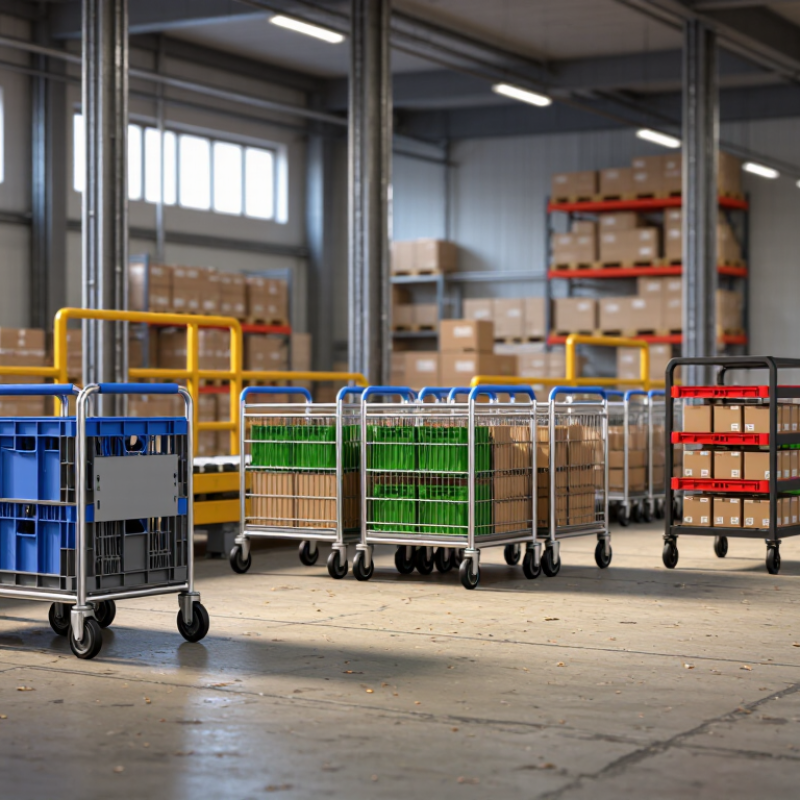
China Top 10 Logistics Trolleys Manufacturers to Buy From

Logistics Trolleys: Definition, Types, and Main Industrial Applications

Logistics trolleys are manually pushed or pulled platforms that move cartons, tools, bins, or components across short industrial distances. They reduce repeated lifting, especially between storage racks, packing stations, and dispatch areas. Common types include two-wheel hand trucks, four-wheel platform carts, cage trolleys, shelf trolleys, and specialized roll containers. Each design suits a different load pattern. Wheels matter more than many buyers expect.

Grand View Research reported that the global material handling equipment market was valued at about USD 212 billion in 2023. Its projected growth reflects wider investment in warehouses, factories, and distribution networks. In these environments, trolleys support order picking, line feeding, maintenance, retail replenishment, and hospital logistics. Steel frames suit heavy industrial loads, while aluminum models improve portability. Locking casters help on ramps and uneven floors. A poor wheel choice can slow an entire shift.

MHI’s 2024 Annual Industry Report identified labor availability and operational efficiency as continuing supply-chain concerns. This explains the demand for simple equipment that needs little training. When assessing Chinese manufacturers, buyers should check rated capacity, weld quality, wheel durability, handle height, spare-part access, and load-testing records. Product photographs are not enough. One weakness remains: published trolley data often uses different testing methods, making direct comparisons difficult. Practical trials on the actual floor surface are still essential.


How to Evaluate Chinese Logistics Trolley Manufacturers

When evaluating Chinese logistics trolley manufacturers, start with the factory, not the catalog. Ask for production photos, workshop capacity, and recent export experience. A reliable supplier should explain its steel grades, welding process, surface treatment, and quality checkpoints clearly.

Request a sample before placing a large order. Load it with the intended weight, then inspect frame movement, caster noise, handle strength, and weld consistency. Measure the trolley after repeated use. Small defects often appear around corners and wheel mounts. Check whether replacement casters, fasteners, and handles are available. This detail matters.

Review test reports carefully. Confirm who issued them, which model they cover, and when testing occurred. A certificate alone proves little. Discuss tolerances, packaging, delivery terms, and inspection procedures in writing. Ask how the manufacturer handles damaged goods or production delays. Slow replies can become expensive later.

I have found that factory visits reveal practical weaknesses. Floors may be uneven, storage may be exposed to moisture, or inspection records may look incomplete. These issues deserve questions, not immediate rejection. Some smaller factories offer strong workmanship but lack polished documentation. That can still create risk. Compare several suppliers using the same checklist, and keep every promised specification in the purchase agreement.

China Top 10 Logistics Trolleys Manufacturers to Buy From - How to Evaluate Chinese Logistics Trolley Manufacturers
Rank Anonymous Manufacturer Profile Typical Trolley Type Typical Load Capacity Common Trolley Size Frame and Deck Materials Wheel Configuration Customization Capability Quality Evidence to Request Typical Export Lead Time Evaluation Score
1 Profile A: Large-scale industrial handling supplier Heavy-duty platform trolley 500–1,000 kg 1,200 × 750 mm Powder-coated steel frame; steel or rubber-covered deck 2 fixed + 2 swivel casters, usually with brakes High: deck size, handles, casters, color and logo options Load test report, material certificate, dimensional inspection record 25–40 days 9.2/10
2 Profile B: Warehouse equipment specialist Two-tier warehouse trolley 300–600 kg 1,000 × 600 mm Cold-rolled steel; anti-slip steel shelves 4 swivel casters, 2 with brakes High: shelf spacing, guard rails and handle design Factory audit, wheel durability test, coating thickness record 20–35 days 9.0/10
3 Profile C: Stainless-steel equipment manufacturer Hygienic logistics trolley 200–400 kg 900 × 600 mm 304 stainless steel; welded or folded deck 4 non-marking swivel casters Medium to high: dimensions, shelf count and caster selection Stainless-steel grade certificate, weld inspection, corrosion-resistance evidence 30–45 days 8.8/10
4 Profile D: Retail and commercial cart manufacturer Light-duty stock trolley 150–300 kg 900 × 500 mm Painted steel or aluminum frame; wire or sheet deck 2 fixed + 2 swivel casters High: baskets, side rails, handles and color matching Prototype approval, weld quality inspection, wheel load test 20–30 days 8.6/10
5 Profile E: Modular material-handling supplier Multi-tier picking trolley 250–500 kg 1,100 × 650 mm Powder-coated steel; adjustable shelves 4 swivel casters with optional brakes High: modular shelf height and accessory integration Assembly drawing, static-load test, spare-parts list 25–40 days 8.5/10
6 Profile F: Folding and space-saving trolley supplier Folding platform trolley 100–300 kg 900 × 600 mm Steel or aluminum frame; textured polymer deck 2 fixed + 2 swivel folding casters Medium: handle height, deck size and wheel material Folding-cycle test, safety-lock inspection, packed-dimension record 20–35 days 8.3/10
7 Profile G: Plastic logistics equipment manufacturer Plastic platform or roll-container trolley 150–500 kg 1,200 × 800 mm Injection-molded HDPE or PP platform; steel reinforcement where required 4 industrial casters, commonly 2 braked Medium: color, platform dimensions and caster specification Plastic material declaration, impact test, wheel attachment inspection 30–50 days 8.1/10
8 Profile H: Export-oriented custom fabrication supplier Custom industrial trolley 300–800 kg Project-specific Carbon steel, stainless steel or aluminum according to application Specified according to load, floor type and maneuverability Very high: drawings, fixtures, handles, brakes and surface finish Approved drawings, first-article inspection, final inspection report 35–60 days 8.0/10
9 Profile I: Small-batch warehouse accessory supplier Utility and order-picking trolley 100–250 kg 800 × 500 mm Painted steel; mesh, wire or laminated shelves 4 swivel casters, optional locking wheels Medium: shelf configuration and handle height Sample inspection, basic load test, packaging drop-test evidence 15–30 days 7.8/10
10 Profile J: Cost-focused general trolley manufacturer Basic flatbed warehouse trolley 150–400 kg 900 × 600 mm Painted carbon steel; rubber or PVC-covered deck 2 fixed + 2 swivel casters Medium: color, handle shape and wheel selection Pre-shipment inspection, load-rating confirmation, carton specification 20–35 days 7.6/10
Evaluation basis: Scores are based on manufacturing flexibility, load-range coverage, customization capability, quality documentation, export readiness and lead-time performance. Actual capacity, dimensions, materials, pricing and delivery dates should be confirmed through technical drawings, samples, inspection records and a written quotation before purchase.

China’s Top 10 Logistics Trolley Manufacturers and Their Strengths

China’s top 10 logistics trolley manufacturers stand out through practical strengths, not attractive catalogs alone. Several focus on heavy-duty steel frames, reinforced corners, and quiet casters for warehouses. Others specialize in lightweight aluminum models for retail, parcel handling, and short-distance movement. Their product ranges often include nesting trolleys, platform carts, cage trolleys, and folding units.

Experienced buyers should examine load ratings under real working conditions. A trolley carrying 300 kilograms on a smooth floor may perform differently on ramps or damaged concrete. Strong manufacturers usually provide clear material details, wheel specifications, welding standards, and replacement-part support. Many also offer customized dimensions, printed markings, and corrosion-resistant finishes. However, no supplier is perfect. Some catalogs look professional, but actual samples may reveal rough welds or unstable handles. That is worth checking.

Tips: Request a sample before placing a large order. Test wheel movement, braking, noise, frame strength, and folding performance. Ask for inspection records and packaging photos. Confirm whether spare casters are available. Small details matter.

The strongest manufacturers combine stable production with responsive communication. They understand export packaging, container loading, and different warehouse layouts. Their advantage is flexibility. Yet buyers should compare factory experience, quality control, delivery consistency, and after-sales service together. A low quotation can become expensive when wheels fail early or dimensions arrive incorrectly.

Key Features, Customization Options, and Quality Standards

When comparing China’s top ten logistics trolley manufacturers, inspect features beyond load capacity. A strong trolley should roll smoothly under its stated weight. Check frame thickness, weld consistency, caster diameter, handle comfort, and brake response. Uneven weld beads can signal rushed production. That matters.

Customization often separates a useful trolley from an expensive obstruction. Buyers may request specific platform sizes, shelf spacing, handle heights, caster materials, and wheel configurations. Powder coating improves surface protection in warehouses. Stainless steel may suit damp areas or frequent cleaning. Anti-static wheels can support sensitive handling environments. Ask for sample drawings before approving mass production. Small details matter.

Reliable manufacturers should provide clear load ratings, dimensional tolerances, inspection records, and material information. ISO 9001-based quality systems can show process discipline, but certification alone proves little. Request weld inspections, caster tests, coating checks, and packaging evaluations. Traceable batch records also help resolve defects quickly. I have found that practical trials reveal problems that documents miss, especially turning resistance on uneven floors.

No trolley is perfect.

A prototype may still need stronger corner protection or quieter wheels. Buyers should compare test results with daily warehouse conditions, not only catalogue promises. Suppliers that explain limitations openly often deserve closer technical review.

How to Choose and Purchase the Right Logistics Trolley Supplier

China Top 10 Logistics Trolleys Manufacturers to Buy From

Choosing the right logistics trolley supplier requires more than comparing catalog prices. The MHI Annual Industry Report 2024 surveyed over 1,650 supply chain professionals. It found that 55% planned to increase technology and innovation investment. This signals a practical shift toward safer, more efficient material handling.

Start with your actual workflow. Measure aisle width, load weight, platform size, ramp angles, and daily operating hours. Ask suppliers for rated-load test records, wheel specifications, braking performance, and corrosion-test results. products aligned with recognized safety requirements, such as EN 1757-3 where applicable, deserve closer review. A 500-kilogram trolley may fail early if its frame, welds, or casters are poorly matched.

Request a sample before placing a large order. Push it across uneven flooring. Check handle vibration, turning radius, noise, and brake response. Small details matter. I once underestimated wheel noise in a busy warehouse. It became a daily complaint. Compare total cost, including spare casters, packaging, replacement parts, inspection, and delivery time. The World Bank’s Logistics Performance Index 2023 emphasizes reliability, service quality, and shipment timeliness. Therefore, evaluate production controls and communication, not only factory capacity. Ask for quality certificates, batch inspection photos, clear warranty terms, and a realistic lead time. A cheaper supplier can still become expensive when after-sales support is weak.

CNC machining CAD export file formats

Put your parts in production today

Get an instant quote