Seamless Steel Tube supports systems where pressure, heat, and reliability cannot be treated casually. Unlike welded tube, it is formed from a solid billet and pierced into a hollow shape. This process removes a longitudinal weld seam, creating a continuous tube wall. That difference matters.
Metallurgist George Krauss, author of Steels: Processing, Structure, and Performance, offers a useful principle: “Steel performance depends on processing, structure, and properties.” His point applies directly here. A tube’s service life depends on more than its label. Grade, wall thickness, heat treatment, surface condition, and inspection all influence performance. A poorly selected tube can fail quietly.
Pressure changes everything.
In oil and gas facilities, Seamless Steel Tube carries crude oil, natural gas, hydraulic fluids, and high-pressure process media. Refineries and chemical plants use it in heat exchangers, boilers, and process piping. Power stations rely on heat-resistant grades for steam lines, superheaters, and feedwater systems. In automotive manufacturing, smaller seamless tubes support fuel systems, hydraulic parts, and precision components. Construction equipment also uses them in cylinders, axles, and structural assemblies.
The choice is not always obvious. Seamless tube often costs more than welded tube, especially in large sizes. Its production may also create dimensional limits and material waste. Engineers must compare pressure ratings, corrosion exposure, temperature, fatigue cycles, and applicable standards before purchasing. A shiny surface proves little. Mill certificates, ultrasonic testing, hydrostatic testing, and traceable quality records provide stronger evidence.
This article examines where Seamless Steel Tube is used, why engineers specify it, and when another tube option may be more practical. Real-world service conditions remain the final judge.
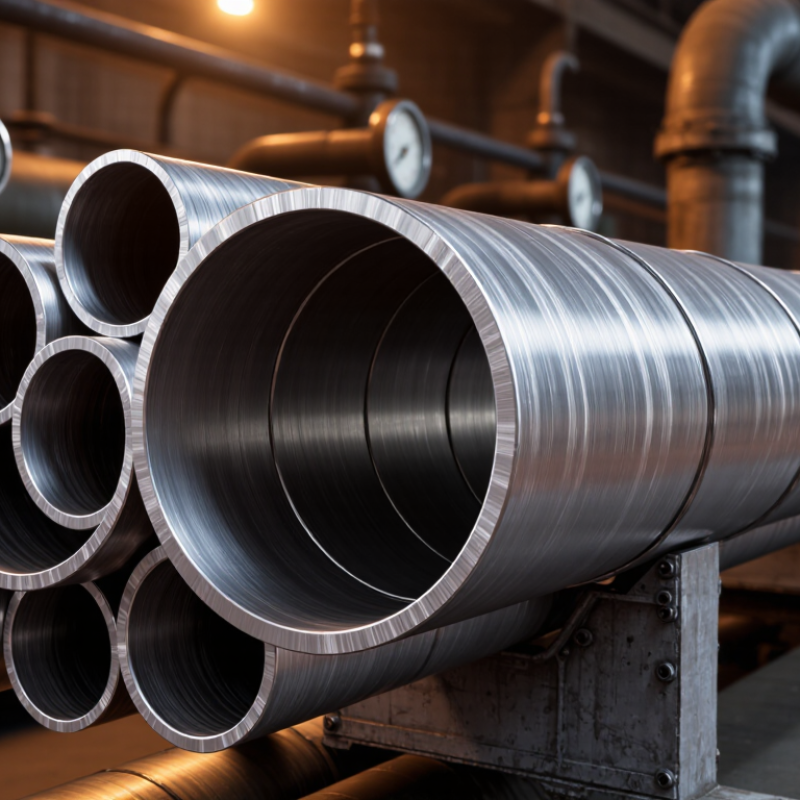
A seamless steel tube is a hollow steel product made without a longitudinal weld. Manufacturers usually heat a solid steel billet, pierce its center, and roll it into a hollow shape. Further cold drawing or heat treatment can improve its dimensions, surface quality, and mechanical properties. It has no weld. That detail matters.
Seamless tubes are selected when pressure resistance, smooth internal flow, or dependable performance is important. They appear in boilers, heat exchangers, hydraulic systems, oil and gas equipment, automotive parts, and structural assemblies. Engineers may also use them for shafts, cylinders, and high-temperature pipelines. Their strength comes from continuous steel around the tube, but seamless does not mean flawless or automatically stronger. That assumption is incomplete.
Wall thickness, steel grade, manufacturing method, and heat treatment all affect performance. During practical inspections, technicians check outside diameter, wall thickness, straightness, hardness, and surface defects. Ultrasonic or hydrostatic testing may reveal hidden problems. The correct tube must also match temperature, pressure, corrosion exposure, and connection requirements. A poorly specified tube can fail despite its seamless construction. Not always. Careful sizing and traceable quality records remain essential.
| Application Area | Typical Service Conditions | Why Seamless Tube Is Used | Common Tube Characteristics | Typical Examples |
|---|---|---|---|---|
| Oil and Gas Transport | Internal pressure, long-distance fluid transport, and exposure to corrosive or abrasive fluids. | The continuous tube wall avoids a longitudinal welded seam and can provide reliable pressure containment when properly specified and manufactured. | Carbon steel or low-alloy steel; controlled wall thickness; pressure-tested supply may be required. | Gathering lines, process piping, well tubing, and high-pressure transmission components. |
| Boilers and Steam Systems | High-temperature water, steam, thermal cycling, and elevated internal pressure. | Seamless construction is widely used for pressure-containing boiler and superheater components designed for demanding thermal service. | Carbon, low-alloy, or stainless steel selected for temperature and pressure requirements. | Boiler tubes, superheater tubes, water-wall tubes, and steam piping. |
| Heat Exchangers | Heat transfer between liquids or gases, often with pressure and temperature differences across the tube wall. | Uniform dimensions and a continuous wall support dependable heat transfer and pressure separation. | Carbon steel, stainless steel, or other heat-resistant alloys; smooth internal surfaces may be specified. | Shell-and-tube exchanger tubes, condenser tubes, and process-heating equipment. |
| Hydraulic and Pneumatic Systems | High fluid pressure, repeated pressure cycles, and close dimensional requirements. | The tube can be cold-drawn or precision-finished to achieve accurate dimensions and a smooth bore for fluid control. | Precision outside diameter, controlled wall thickness, low surface roughness, and good concentricity. | Hydraulic cylinders, pneumatic cylinders, pressure lines, and actuator components. |
| Automotive and Transportation | Vibration, cyclic loading, impact, and the need for weight-efficient components. | Seamless tubes can be formed into strong, lightweight components with consistent mechanical properties around the circumference. | Low-carbon or alloy steel; supplied for bending, forming, machining, or heat treatment. | Drive shafts, axle components, steering parts, suspension components, and structural members. |
| Mechanical Engineering | Static loads, rotating loads, machining operations, and general fabrication requirements. | The absence of a welded seam can simplify applications where uniformity, machinability, or resistance to localized seam-related defects is important. | Carbon steel, alloy steel, or stainless steel; available in hot-finished or cold-finished forms. | Machine shafts, rollers, gears, sleeves, bushings, and fabricated equipment parts. |
| Structural Construction | Compression, tension, bending, impact, and outdoor environmental exposure. | Round seamless sections provide efficient load distribution and can be used where structural reliability and clean geometry are required. | Structural carbon steel or low-alloy steel; corrosion protection may be added separately. | Columns, frames, trusses, railings, support posts, and tubular structures. |
| Chemical and Process Equipment | Contact with chemicals, elevated temperatures, pressure, and potentially corrosive process media. | Seamless tubes can be selected with corrosion-resistant alloys and a continuous wall suited to pressure-containing process equipment. | Stainless steel, duplex stainless steel, nickel alloys, or other materials chosen for the process environment. | Process piping, reactor components, instrumentation lines, and chemical plant equipment. |
| Mining and Heavy Equipment | High impact, abrasion, vibration, and heavy hydraulic loading. | Strong tube sections can withstand demanding mechanical service when the material, wall thickness, and heat treatment are correctly selected. | Alloy steel or wear-resistant steel; heavy-wall designs are common in high-load applications. | Hydraulic cylinders, drill components, support structures, and equipment frames. |
| General Fluid Conveyance | Transport of water, oil, gas, air, or other fluids under low, medium, or high pressure. | Seamless tubes offer a continuous pressure boundary and are available in a wide range of sizes, grades, and wall thicknesses. | Material and dimensions selected according to pressure, temperature, corrosion, and applicable design requirements. | Industrial piping, compressed-air systems, pump connections, and utility lines. |
A seamless steel tube is produced from a solid steel billet that is pierced and formed into a hollow section without a longitudinal weld. The appropriate tube grade, dimensions, manufacturing process, and inspection requirements depend on the application, operating pressure, temperature, corrosion conditions, and applicable engineering standard.