How to Choose an Inverter Voltage Stabilizer?
Choosing an Inverter Voltage Stabilizer is not simply a matter of matching a voltage number. It is a power-quality decision shaped by equipment sensitivity, load behavior, and local grid conditions. A refrigerator may draw sharp starting current. A server may react badly to brief voltage dips. A workshop motor may create electrical noise that household electronics never show. These details matter more than a glossy product label.
Power-quality expert Roger C. Dugan, co-author of Electrical Power Systems Quality, states, “Power quality is a compatibility problem between the source and the equipment.” That principle gives this guide its direction. The right stabilizer must suit the load, not merely display an impressive correction range. It should also work with the inverter’s waveform, battery system, and protection settings.
This guide examines capacity, response time, output waveform, efficiency, bypass operation, and installation conditions. It explains why apparent power in VA cannot be treated as equal to usable watts. It also considers crest factor, overload duration, thermal limits, and grounding requirements. A unit that looks adequate on paper may overheat beside a dusty machine or trip during a compressor start.
Measurements help. So does restraint. Before buying, record input voltage at different hours, identify the heaviest startup load, and check the manufacturer’s test data. Cheap choices can become expensive. There is no perfect specification. A stabilizer designed for office electronics may disappoint in a rural workshop. Likewise, an industrial model may waste energy in a small home. Real installations often behave differently from brochures.
Understanding How an Inverter Voltage Stabilizer Works
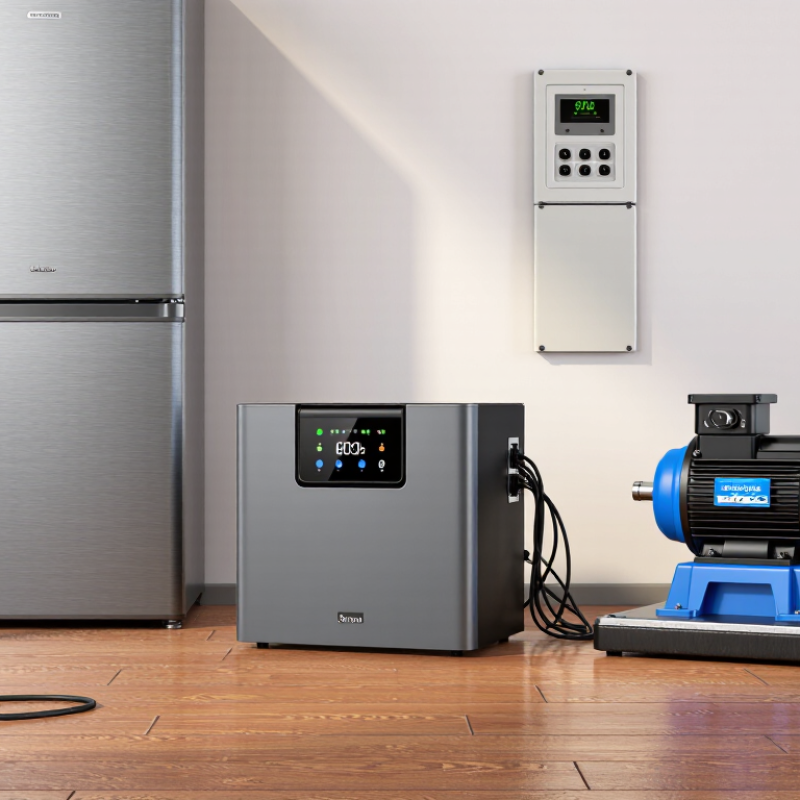
An inverter voltage stabilizer protects equipment by rebuilding the power waveform, not merely reducing excess voltage. Incoming AC power is rectified into DC, then stored briefly in a DC link. An inverter converts that energy back into controlled AC output. A feedback sensor checks voltage several times per cycle. The controller adjusts switching pulses when the input rises, falls, or distorts. The result is steadier power for servers, medical instruments, and precision motors.
Real conditions are less tidy. Voltage may sag when compressors start, or fluctuate during storm-related grid changes. IEEE 1159 classifies these events as sags, swells, interruptions, and transients. Its guidance supports measuring disturbances before selecting equipment. The Uptime Institute’s 2023 Global Data Center Survey reported that 60% of respondents experienced an outage during the previous three years. That figure makes monitoring more than a technical luxury.
Choose a unit after recording the site’s lowest and highest voltage, load current, crest factor, and starting surge. Check continuous kVA, overload time, response speed, output regulation, and bypass behavior. A low-cost model may show excellent regulation on a clean test bench, yet struggle with nonlinear loads. That is the uncomfortable part. No stabilizer fixes poor wiring or an undersized generator. Request IEC 61000-4-30-compatible power-quality measurements where possible, and compare the measured waveform with the stabilizer’s published limits. Load diversity also matters; a motor’s brief surge can exceed its nameplate rating.
Identifying Your Equipment’s Voltage and Power Requirements
How to Choose an Inverter Voltage Stabilizer?
Begin with the equipment nameplate, not an estimate. Record nominal voltage, frequency, running current, and rated watts. A device marked 230 V should not receive a stabilizer designed for 110 V systems. IEC 60038 identifies 230 V as a standard low-voltage supply in many regions. EN 50160 also states that supply voltage should remain within ±10% of nominal for 95% of 10-minute intervals during a week. Real sites can perform worse. Measure voltage with a true-RMS meter during quiet hours and peak demand.
Power sizing needs more care. For single-phase AC equipment, apparent power is VA = volts × amps. Watts also depend on power factor. Motors, compressors, pumps, and transformer-based devices may draw several times their running current at startup, according to guidance from the U.S. Department of Energy. Check both values. A 1,000 W load may still require a stabilizer above 1,000 VA. Add practical headroom, often 25–30%, after calculating the measured load.
Do not combine sensitive electronics with heavy motors casually. Their startup surge can cause temporary voltage dips. An inverter stabilizer should match the input range, output voltage, waveform, frequency, and overload response. Confirm battery capacity too. Short backup time may be acceptable, but repeated low-voltage shutdowns are not. I would recheck the calculation after installation. Cable losses, ambient heat, and future equipment can invalidate a perfect spreadsheet. Measure again under real operating conditions.
How to Choose an Inverter Voltage Stabilizer?
Compare the equipment’s typical running power with its possible startup demand. Choose a stabilizer that supports the correct nominal voltage and provides additional capacity for motor-driven loads.
Selection guidance: Add the running wattages of all devices that may operate at the same time. For refrigerators and pumps, allow extra capacity for startup current. Always confirm the voltage, frequency, and power rating on each equipment nameplate before selecting a stabilizer.
Comparing Stabilizer Types, Capacity, and Voltage Regulation Range
How to Choose an Inverter Voltage Stabilizer?
An inverter voltage stabilizer should match both the inverter and the electrical load. Relay-based stabilizers are affordable and respond in steps. They suit refrigerators, lights, and basic home circuits. Servo stabilizers adjust voltage more smoothly. They work well where voltage changes frequently. Static stabilizers react quickly and create little electrical noise. They usually cost more.
I once underestimated switching speed. Sensitive equipment exposed brief voltage dips that the relay unit could not correct.
Capacity needs more attention than the label suggests. Add the running wattage of connected appliances, then allow space for startup surges. A refrigerator compressor may briefly demand several times its normal power. Motors and pumps can behave similarly.
Convert watts to VA when necessary, using the equipment power factor. A practical margin of 25 to 40 percent is reasonable for many installations. Bigger is not automatically safer. An oversized unit can be inefficient and harder to protect.
Check the input voltage regulation range before buying. Measure the wall voltage at different times, especially during evening demand. A stabilizer rated for 160–260 volts may fail to help when supply falls below 160 volts. Its output range also matters. Many inverters need a steady 220 or 230 volts. Confirm the tolerance stated in the inverter manual.
Look for overload protection, thermal protection, bypass operation, and a clear display. Installation should include proper earthing and cable sizing.
My own early choice focused too much on capacity. The voltage range proved more important.