Get an instant quote
Get in touch Listen to our podcast

Blog

Top 10 Best Rapid 3D Printing Technologies to Watch in 2026?

As we approach 2026, the landscape of rapid 3D printing is set to evolve dramatically. The global 3D printing market is projected to reach $62.79 billion by 2026, driven by innovations in rapid manufacturing and material sciences. Industry leaders are focusing on efficiency, accuracy, and sustainability. These innovations promise to enhance production speed while reducing waste.

Rapid 3D printing technologies are not just about speed; they encompass a range of advancements. For instance, advancements in polymer and metal printing techniques are pushing boundaries. Companies like Stratasys and HP are leading the charge, offering new machines that can print complex geometries faster than ever before. Yet, despite these advancements, challenges remain regarding standardization and material performance.

The need for industry-specific solutions is more pressing than ever. As sectors like aerospace and healthcare adopt 3D printing, the demand for rapid, reliable, and high-quality outputs grows. It is crucial to reflect on how these technologies will integrate into existing workflows. With ongoing investments and research, the future of rapid 3D printing holds incredible promise, but it also requires careful consideration and adaptation.

Top 10 Best Rapid 3D Printing Technologies to Watch in 2026?

Emerging Trends in 3D Printing Technologies for 2026

As we approach 2026, the 3D printing landscape is evolving rapidly. Emerging trends indicate a shift towards more sustainable materials. According to a recent industry report, eco-friendly 3D printing materials could capture 40% of the market share by 2026. This highlights the growing demand for technologies that reduce waste and environmental impact.

Another trend gaining traction is the adoption of advanced software integration. Machine learning algorithms can optimize print quality and speed. A study found that using AI can enhance efficiency by as much as 30%. However, integration challenges remain. Companies must reevaluate their workflows to successfully implement these advanced technologies.

Tips: Businesses must remain flexible. Explore various materials and methods to find the best fit for your production needs. Prototyping with new technologies is vital. It may uncover unforeseen issues. Continuous learning and adaptation will remain key in this fast-changing industry. Embrace the uncertainty for greater innovation potential.


Overview of Rapid 3D Printing Methods on the Market

Rapid 3D printing technologies are transforming various industries. In 2026, several methods are expected to dominate the market. Technologies such as Material Jetting and Binder Jetting are gaining attention. According to a recent industry report, the global 3D printing market is projected to reach $34.8 billion by 2026, reflecting a CAGR of 23.5%. This growth highlights the industry's shift towards faster production and customization.

Material Extrusion remains a well-known method. It allows the use of a wide range of materials. However, it can be slow and may require post-processing. On the other hand, Laser Powder Bed Fusion offers high precision. Yet, it often faces challenges concerning speed and cost-effectiveness. This balance between quality and efficiency is crucial for manufacturers. They must evaluate the trade-offs in pursuing rapid production.

Innovations are constantly emerging, yet not every technology will succeed. Some methods may struggle with material limitations or production speeds. Continuous research is vital. Companies must be adaptable to these challenges. Understanding the nuances of each technology can lead to more informed decisions. Keeping an eye on the evolving market landscape will be essential for any business aiming to leverage 3D printing effectively.

Top 10 Best Rapid 3D Printing Technologies to Watch in 2026

Technology Printing Speed (mm/h) Material Types Applications Overview
Fused Deposition Modeling (FDM) 50-300 Plastics, Composites Prototyping, Hobbyist Projects Affordable and widely used for various applications.
Stereolithography (SLA) 30-100 Resins Dental, Jewelry, Prototyping High accuracy and smooth surface finishes.
Selective Laser Sintering (SLS) 10-20 Powders (Nylon, Metals) Functional Parts, Aerospace, Automotive Suitable for complex geometries and strong parts.
Digital Light Processing (DLP) 20-80 Resins Rapid Prototyping, Dental Parts Fast layer curing for quicker print times.
Binder Jetting 10-50 Sand, Metals, Ceramics Sand Casting, Architectural Models Good for large volumes and low-cost production.
Material Jetting 20-100 Photopolymers Prototypes, Multicolor Parts Can produce multi-material and colorful parts.
Electron Beam Melting (EBM) 10-30 Metals Aerospace, Medical Implants Used for high-performance metal parts.
Continuous Liquid Interface Production (CLIP) 100-500 Photopolymers Consumer Goods, Prototyping Fastest method for producing high-quality parts.
Multijet Fusion (MJF) 30-100 Nylon, Polymers Functional Prototypes, Production Parts Produces strong, durable parts with good surface quality.

Innovative Materials Shaping the Future of 3D Printing

The future of 3D printing is increasingly shaped by innovative materials. These materials drive versatility and enhance the efficiency of the printing process. In recent years, advancements in metal, polymers, and biocompatible materials have paved the way for new applications across industries.

A report by IDTechEx predicts that the 3D printing market will grow to $36 billion by 2026. This growth hinges on material innovation. For instance, new thermoplastic materials are improving mechanical properties. They enable the production of lighter, stronger parts. With the rise of bioprinting, materials like bioinks are revolutionizing healthcare applications. These innovations provide promising solutions for tissue engineering and personalized medicine.

Tips: When exploring materials, look for those with high thermal stability. This ensures better performance under various conditions. Always evaluate the compatibility of materials with existing processes. Discrepancies can lead to costly failures or subpar results. It’s important to remain open to experimentation. Sometimes, unexpected combinations yield impressive results.

Impact of Automation and AI on 3D Printing Processes

Top 10 Best Rapid 3D Printing Technologies to Watch in 2026?

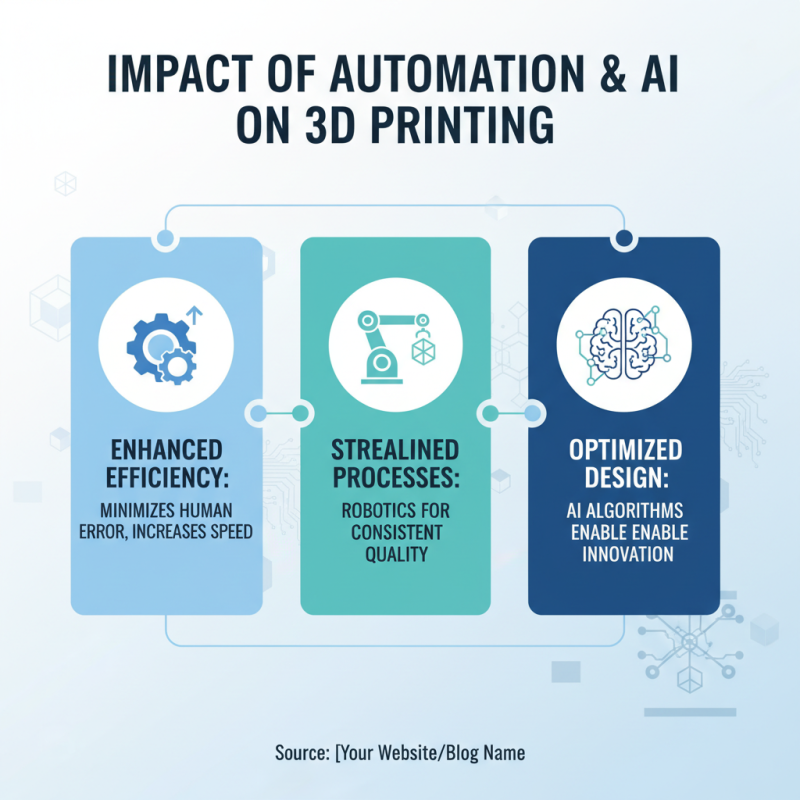
The integration of automation and AI in 3D printing is transforming processes significantly. Automation enhances efficiency by minimizing human error and increasing production speed. Robotics streamline complex tasks, leading to consistent quality in output. AI algorithms optimize design, allowing for innovation that was previously unattainable.

Consider the role of AI in predicting material behavior. Machine learning can analyze data from previous prints, offering insights that improve future designs. However, reliance on automation may pose challenges. When machines control the workflow, human oversight can diminish. Critical decisions often require human intuition, which machines may not replicate effectively.

This evolving landscape also presents a paradox. While automation boosts productivity, it risks creating a disconnect between designers and the physical aspects of their work. The intricacies of craftsmanship could be overshadowed by a focus on efficiency. Embracing these technologies means navigating the delicate balance between innovation and maintaining a hands-on approach to creation.

Potential Applications and Industries for Rapid 3D Printing

Rapid 3D printing technology is poised to reshape various industries by 2026. Its potential applications range from healthcare to aerospace, each offering unique benefits. For instance, in healthcare, rapid 3D printing can create personalized implants and prosthetics. This technology allows for custom designs based on individual patient anatomy. A report from the Wohlers Associates states that the medical sector will witness a 26.4% compound annual growth rate by 2026.

In the automotive industry, rapid 3D printing aids in producing lightweight components. This can improve fuel efficiency and reduce emissions. By 2025, the automotive market is expected to reach $3.2 billion, according to a study by MarketsandMarkets. Additionally, rapid prototyping enables faster design iterations, allowing manufacturers to test concepts quickly. However, challenges remain. Quality control and material costs need to be addressed for broader adoption.

The aerospace sector can also benefit significantly from rapid 3D printing. It allows for more complex designs that traditional methods cannot achieve. This flexibility leads to weight reduction and cost savings in production. Yet, the industry still grapples with regulatory hurdles and material certification issues. Addressing these complications will be crucial for future advancements. Each application presents opportunities and challenges, indicating a need for ongoing exploration and innovation.

CNC machining CAD export file formats

Put your parts in production today

Get an instant quote