Buying a concrete batching plant in 2026 demands more than comparing output ratings and prices. It requires a clear view of your projects, materials, labor, and local operating conditions. A plant producing 120 cubic meters per hour may look impressive. However, its real value depends on consistent moisture control, accurate weighing, fast maintenance, and reliable automation.
Concrete expert Pierre-Claude Aïtcin once said, “Concrete is a material with a memory.” This insight matters when selecting Concrete Batching plants. Small errors in water, cement, or aggregate proportions can affect strength, workability, and long-term durability. Buyers should inspect weighing tolerances, mixer performance, dust-control systems, software access, and spare-parts support. Ask for operating records, not only brochures. Visit a working installation if possible. Watch the discharge cycle. Listen for unusual vibration.
This guide examines the practical decisions behind a 2026 purchase. It compares stationary, mobile, compact, and high-performance configurations. It also considers energy use, recycled aggregates, washout management, transport distance, and future expansion. The cheapest option may become expensive after repeated downtime. That lesson is easy to overlook.
No plant fits every site. Soil conditions, climate, aggregate size, and production schedules can change the answer. Buyers may also underestimate operator training. That is a real weakness. A technically advanced system still fails when calibration is neglected. Careful planning, supplier verification, and honest cost analysis create a stronger buying decision. The right plant should support quality concrete today and remain adaptable as project demands change.
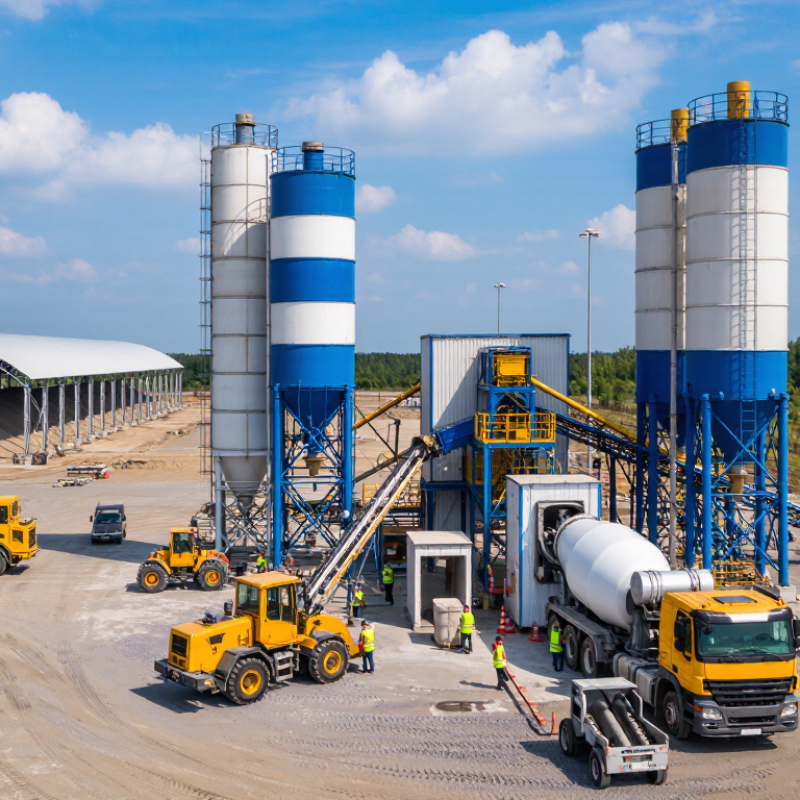
A concrete batching plant combines cement, aggregates, water, and admixtures into uniform concrete. It may serve construction sites, precast yards, or infrastructure projects. The process begins with aggregate bins holding sand and stone in separate compartments. Weighing systems measure each material according to the selected mix design.
Measured aggregates move through conveyors or skip hoists. Cement travels from a sealed silo into a weighing hopper.
Water and liquid admixtures enter through calibrated pipes. The control system coordinates these steps and records each batch.
The mixer then blends the materials until the concrete reaches a consistent texture. A well-designed plant reduces manual errors and supports repeatable production.
Real operation is less perfect than a diagram suggests. Wet sand can change the actual water content quickly. Operators should check moisture, inspect scales, and clean buildup around the mixer.
Small errors matter. A few extra kilograms of water can reduce strength or increase cracking risk.
Regular calibration, documented testing, and trained supervision improve reliability. Dust control, guarded moving parts, and emergency stops also protect workers. I have found that automatic controls help, but they cannot replace practical judgment. A sensor may report normal conditions while a blocked chute quietly slows production.
Concrete batching plants serve different construction conditions, output targets, and material-handling needs.
Stationary batching plants suit bridges, tunnels, and large commercial projects. They provide stable production beside a prepared foundation. Their silos, conveyors, and control systems support consistent batch quality. However, relocation is expensive and time-consuming.
Mobile batching plants fit roadworks, housing developments, and remote sites. Their modular structure allows faster installation near changing work zones. This can reduce concrete delivery time and traffic exposure. Compact plants work well in urban areas with limited space. They often sacrifice some storage capacity.
Dry-mix plants measure and blend ingredients before water is added at the mixer truck. They require less equipment on site but depend heavily on accurate truck mixing.
Wet-mix plants produce a fully blended mixture inside the plant. They offer stronger control over consistency, especially for high-volume pours.
Continuous batching plants support steady production for highways, dams, and large foundations. They are efficient when demand remains stable.
Intermittent plants suit varied recipes and smaller projects.
During selection, engineers should examine daily output, aggregate moisture, power supply, transport access, and maintenance skills.
A common mistake is choosing capacity by peak demand alone. Idle equipment still consumes space and money.
Even a technically advanced plant can perform poorly when operators lack training or quality checks. Weather can also change results. Rain, dust, and temperature deserve practical planning.
Buying a concrete batching plant in 2026 starts with measurable specifications, not catalog photographs. Confirm rated output, then test practical output under your own mix design. A 60 m³/h label may fall lower with frequent aggregate changes, long discharge cycles, or wet-weather delays. The USGS Mineral Commodity Summaries 2025 estimates global cement production at about 4.1 billion metric tons in 2024. That shows market scale, not guaranteed plant utilization. Ask for verified cycle time, batch size, and hourly production records. Numbers should survive a site visit.
Accuracy matters more than impressive capacity. Compare cement, water, admixture, and aggregate tolerances against applicable standards, such as ASTM C94/C94M or EN 206. Check load-cell resolution, calibration access, and automatic correction for aggregate moisture. A 2% moisture variation can significantly change water demand in sand-rich mixes. This detail is often underestimated. Mixer geometry, discharge clearance, liner life, and clean-out time also affect consistency. Request test batches using local aggregates, not ideal laboratory materials.
Controls should record recipes, alarms, operator actions, and calibration history. Cybersecurity and backup operation deserve practical testing. Dust collection, enclosure design, and recycled-water handling require evaluation against local conditions. The IEA reports that cement production contributes roughly 7% of global energy-related CO2 emissions. The GCCA 2050 Roadmap also stresses lower-carbon concrete. Compare energy per cubic metre, idle power, and compatibility with supplementary cementitious materials. Be cautious with optimistic fuel figures. Real sites are messier. Total ownership cost includes spares, training, downtime, and technician response.
Selecting a concrete batching plant in 2026 starts with the project, not the catalogue. Estimate peak hourly demand, total concrete volume, delivery distance, and working hours. A plant rated at 120 cubic meters per hour may deliver less under real conditions. Moisture changes, truck queues, cleaning, and mix changes reduce practical output. A useful planning assumption is 70–85% of the advertised capacity.
Match capacity to the pour schedule. A high-rise foundation may need continuous production, while a rural road project may value mobility and fast setup. Check aggregate bin volume, cement silo capacity, weighing accuracy, mixer cycle time, and backup systems. ACI 304R highlights controlled batching and uniform material handling as key quality factors. Small errors become visible in large pours. Very visible.
Environmental performance also belongs in the specification. The Global Cement and Concrete Association reports that concrete contributes roughly 7% of global carbon dioxide emissions. Select systems that support supplementary cementitious materials, accurate water control, dust management, and lower idle time. These features can reduce waste without weakening production reliability.
Do not size the plant only for the busiest day. Oversizing increases purchase cost, maintenance, and unused energy demand. Undersizing creates overtime, truck congestion, and cold-joint risks. A simple demand model should test normal, peak, delayed-delivery, and rainy-day conditions. It will not predict everything. That is the point: revise the model with local traffic data, supplier performance, and the actual mix design before signing the purchase specification.
2026 Top Concrete Batching Plants Buying Guide
Installation begins with the ground, not the mixer. A level, compacted foundation reduces vibration, settlement, and inaccurate weighing. Keep aggregate bins accessible for loaders, while leaving clear routes for maintenance vehicles. Electrical panels need weather protection, proper grounding, and enough space for safe inspection. Dust-control equipment should connect correctly before production starts. A rushed installation often creates expensive problems later.
During operation, trained staff should check moisture, material levels, weighing accuracy, and emergency stops every shift. Operators must follow the approved mix design, because small water changes can affect strength and workability. Watch the discharge gate closely; hardened concrete can block movement without warning. Keep people away from moving belts, mixers, and loading points. Lockout procedures are essential before clearing jams or entering restricted areas. Simple rules are often ignored during busy deliveries.
Maintenance works best when it is visible and scheduled. Inspect mixer blades, conveyor rollers, seals, lubrication points, and sensors regularly. Remove built-up concrete before it hardens. Record unusual noise, unstable readings, and repeated alarms, even when production continues. I have seen teams postpone minor repairs until a worn part stopped the entire plant. That habit deserves criticism. Safety training should include demonstrations, not only signatures on attendance sheets. Emergency drills may feel inconvenient, yet they reveal missing communication, poor access, and unclear responsibility. Some procedures will still need revision after real operating experience.
| Cookie | Duration | Description |
|---|---|---|
| cookielawinfo-checkbox-analytics | 11 months | This cookie is set by GDPR Cookie Consent plugin. The cookie is used to store the user consent for the cookies in the category "Analytics". |
| cookielawinfo-checkbox-functional | 11 months | The cookie is set by GDPR cookie consent to record the user consent for the cookies in the category "Functional". |
| cookielawinfo-checkbox-necessary | 11 months | This cookie is set by GDPR Cookie Consent plugin. The cookies is used to store the user consent for the cookies in the category "Necessary". |
| cookielawinfo-checkbox-others | 11 months | This cookie is set by GDPR Cookie Consent plugin. The cookie is used to store the user consent for the cookies in the category "Other. |
| cookielawinfo-checkbox-performance | 11 months | This cookie is set by GDPR Cookie Consent plugin. The cookie is used to store the user consent for the cookies in the category "Performance". |
| viewed_cookie_policy | 11 months | The cookie is set by the GDPR Cookie Consent plugin and is used to store whether or not user has consented to the use of cookies. It does not store any personal data. |